
|
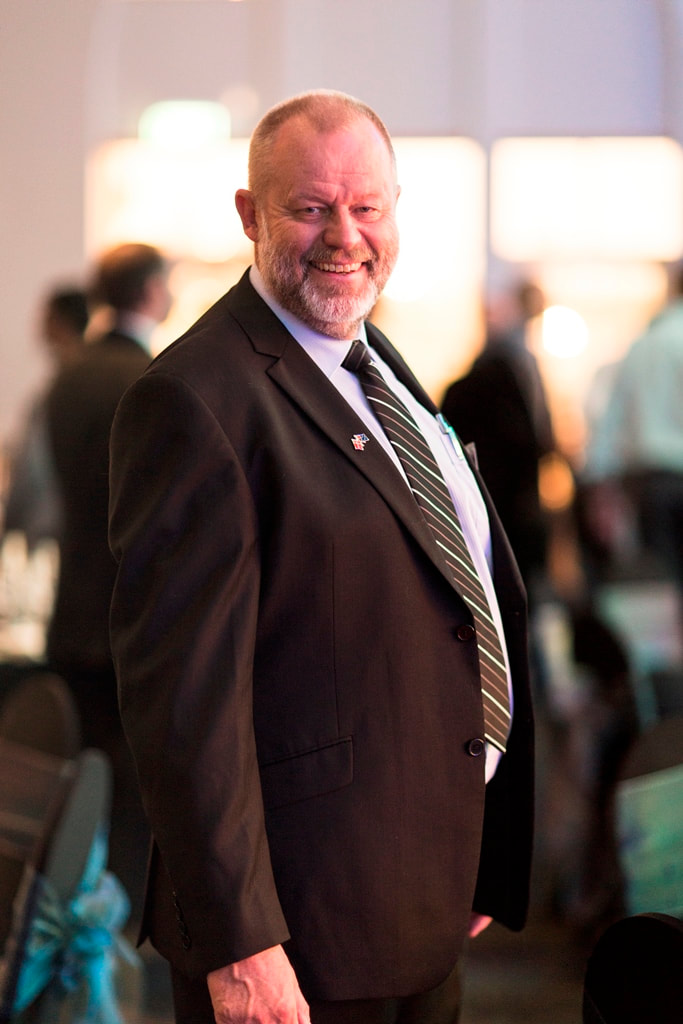
Stefan Jensen, F.AIRAHStefan Jensen, F.AIRAH, is the managing director of Scantec, a leading Australian specialist industrial refrigeration company. With decades of engineering experience in the industry, Jensen is renowned as a pioneer and an expert in energy efficient systems and natural refrigerants.
As of the Institute's 61st Annual General Meeting on May 19, 2020, he is also a retired AIRAH Board Director. Born in the provincial town of Århus, Denmark in 1953, Jensen would very fittingly find out, years later, that his birthplace was just 3km from Sabroe, a renowned manufacturer of industrial refrigeration compressors and refrigeration plants. Of his upbringing and path to industrial refrigeration, Jensen says: "I left school after grade 10, moved south of the border and started an apprenticeship in Germany as an automobile mechanic at age 17. My knowledge of German was limited to what I had learnt at school, but it was refined the hard way, so to speak." Upon completing his apprenticeship in 1973, Jensen was one of only two apprentices out of a pool of 80 completing that year to actually land a job. |
|
What brought you to the HVAC&R industry? A professor by the name of Svend Erik Sørensen. He was the professor for thermodynamics during third year at university and was the supervisor for both the group thesis and my personal thesis (both heat pumps). Mr Sørensen’s career started at Atlas in Copenhagen where he was part of the development of freeze-drying equipment and flake ice makers. He then spent 11 years in the US working for several reputable refrigeration companies, including YORK, before returning to Denmark and starting a teaching career. How long have you been a member of AIRAH? According to my membership certificate, the date of original admission was December 17, 1985. What's your favourite HVAC&R-related memory? When Roy Harlow of Actrol Parts told me the story of selling a small air-cooled, hermetic condensing unit to a yachtie. Roy received a complaint a few days later that the unit was not working. Roy visited the yacht that was moored at the Botanic Gardens in Brisbane. There he was shown the condensing unit, which had been bolted upside down to the ceiling. What's something everyone should know about you, your work, or the HVAC&R industry? In this connected world, almost everyone can know almost whatever they want to know about anyone else. It suffices to say that what you see is what you get as far as the writer is concerned. The refrigeration industry is one of those industries that is almost exclusively dedicated to peaceful purposes and to serving humanity. We can and should make much better use of refrigeration by expanding cold chains across the world to minimise the spoilage of food. It has been estimated that interrupted cold chains are responsible for the spoilage of food that would otherwise feed close to one billion people. Between now and 2050, it has been predicted that the world’s population will grow by two billion people. Much more investment in refrigeration is clearly needed in order to be able to prevent or at least minimise widespread starvation and all the social consequences associated with this. |
How do you see the HVAC&R industry developing over the next 100 years? The Danish multi-artist Robert Storm Petersen (sometimes also referred to as Storm P) is often credited with the saying, “Det er svært at spå, specielt om fremtiden”. The translation is: “Predictions are difficult, particularly when they pertain to the future”. It was actually not Storm P. who said it. It is thought it was a sentence recorded in the Danish Parliament during the years 1935–1939, but the origin of the saying is not known with certainty. In developed nations, the electrical energy consumption of the vapour compression process represents about a quarter of all the electrical energy produced. The vapour compression refrigeration system is the most widely used in all HVAC&R applications by far. There are competing technologies, but low cost, simplicity, and ease of manufacture, installation and service will mean that this will remain the leading technology for decades and possibly a century. What will occur is a technology transformation that will be driven by legislated sustainability measures. Legislated sustainability measures have already been implemented. Prominent examples are the Paris Climate Treaty and the Kigali Amendment to the Montreal Protocol. There are many others – anyone who has ever been involved in a local development approval process would have encountered them. As a result of these and other measures yet to be implemented, synthetic refrigerants of all kinds will have a gradually reducing market share. Over the next century, the market share of synthetic working fluids in vapour compression systems is likely to reduce to 20 per cent or less. A tripling or quadrupling of the number of split air conditioning units between now and 2050 as predicted by some is not sustainable unless these consume 100 per cent renewable electrical energy. As Guus Velders pointed out in 2015, the direct emissions from a leak-tight HFC-based air conditioning system only represent 10 per cent of the emissions problem associated with that technology. The balance (90 per cent) over the life of the plant is represented by indirect emissions if the electricity required to drive these systems is produced by combusting fossil fuels. Where a split air conditioning unit may have a theoretical COP of 2.5 to 3, a large-scale industrial cooling plant for air conditioning may have a COP of approximately 12. This may be even higher if the warm and cold sides of a typical vapour compression system as we apply it today can be utilised simultaneously within the same facility. With increasing urbanisation, the use of water as a refrigerant in very large district cooling plant will likely gain traction. This development will be driven by the necessity to maximise energy efficiency. Large-scale district cooling plants already exist today, but in many cases employing R717 – another natural refrigerant with very good long-term survival prospects, along with R744 and hydrocarbons. The use of water as a refrigerant is not new. About 30 years ago, the LEGO factory in Denmark operated an R718-based water chiller with a two-stage axial compressor. In this plant there were no losses through the heat exchanger walls. The chilled water circulating through the plastic extrusion machines was the actual refrigerant. During the early 1980s in Augustenborg in southern Denmark, a vacuum ice plant for district heating was installed. This plant froze water vapour drawn from the local fjord. The heat extracted from the water by turning it into snow (frozen water particles) was used as a heat source for a heat pump. The German company Efficient Energy GmbH has commercialised R718-based water chillers with unit capacities around 30–40kW for data centres. The claimed energy efficiency is twice that of conventional systems. Recently in Århus, a cascade heat pump using the seawater as heat source was installed. It uses R718 in one of the compression stages. For over a decade, the Danish Technological Institute has been developing a centrifugal compressor for water vapour. Centrifugal compressors for water vapour compression systems suitable in air conditioning applications will become commercially available within the next decade. Last but not least, the very old refrigerant R729 (air) will probably experience a revival over the next century – particularly for low-temperature applications. Low air temperatures below -100°C have well-documented benefits in certain medical therapies. R729-based systems for sashimi are commercially available now, but the technical concept dates back to the first commercial shipment of meat from New Zealand to England in February 1882. |